
By Lisa Jorgensen, Publisher, Lake Chapala Reporter
In August 2014, the Lake Chapala Reporter broke the biggest real estate scandal in Lakeside history. What we called “Real Estategate” turned out to be exactly what it looked like: an illegal price-fixing cartel operating in plain sight, cheating largely elderly retirees out of millions of dollars of their life savings.
Twelve years later, with a booming property market attracting a fresh wave of North American retirees, new licensing laws on the books, and a Mexican government crackdown long behind us, it’s time to ask the question nobody else is asking: has anything really changed?
What happened — and why it mattered
The heart of the Real Estategate scandal was breathtaking in its simplicity. Local real estate associations had formed groups whose bylaws mandated that member agencies charge a minimum of 7% commission on all property sales in order to list on the coveted Multiple Listing Service — the MLS. Independent agencies that refused to participate in this arrangement were excluded from the MLS entirely.
The result, as Mexico’s government commission on economic competition, COFECE, ultimately ruled, was an illegal price-fixing monopoly operating in the Lake Chapala area between 2003 and 2007. The guilty parties read like a who’s who of Lakeside real estate.
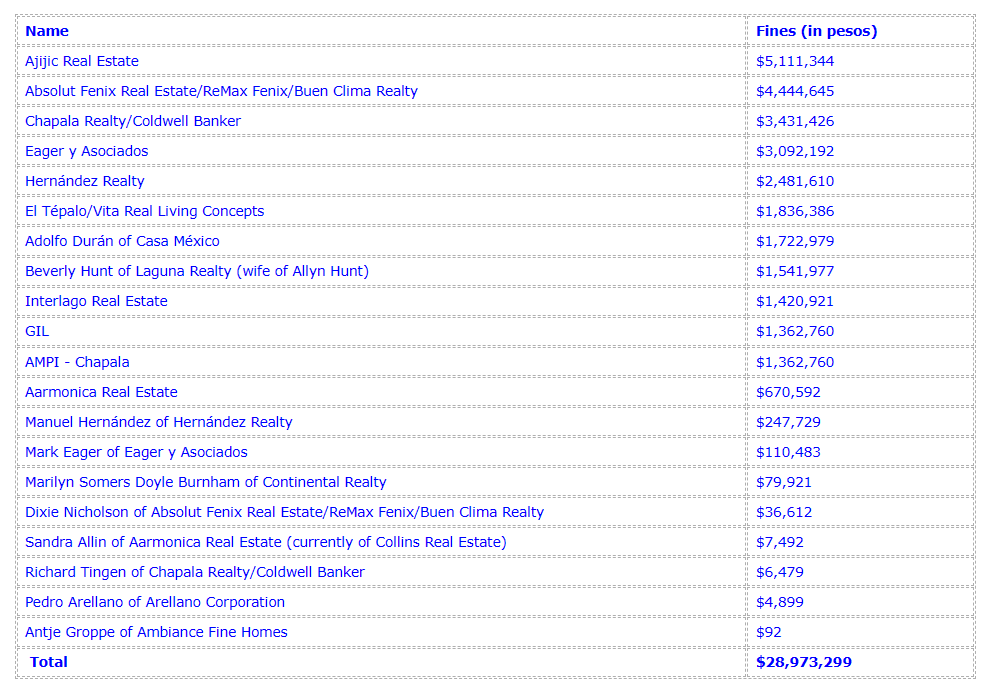
COFECE levied fines totaling 28,973,299 pesos against twenty individuals and agencies. Among the largest:
- Ajijic Real Estate: $5,111,344 pesos
- Absolut Fenix Real Estate/ReMax Fenix: $4,444,645 pesos
- Chapala Realty/Coldwell Banker: $3,431,426 pesos
- Eager y Asociados: $3,092,192 pesos
- Hernández Realty: $2,481,610 pesos
The ruling was final. No further appeals or injunctions would be entertained.
The full details of this ruling can be found on COFECE’s website https://www.cofece.mx/conocenos/pleno/resoluciones-y-opiniones/. Click on this link and enter, for instance, Dixie in the search field Palabra Clave (key word), and click the Buscar button. The result will show case number DE-019-2007. The documents are all available there.
Mexico’s tax authority SAT moved aggressively to collect the fines — an effort complicated by some guilty parties having fled the country, others having transferred assets to family members, and some having deliberately renamed their agencies to obscure their identities.
The real estate community had been exposed. But exposure and reform are two different things.
What changed after the ruling
Two developments since Real Estategate are worth noting for anyone buying or selling property in Lake Chapala today.
First, the legitimate commission norms. Following the COFECE ruling, the accepted standard rates became 5% for residential property sales and 7% for lots — meaningfully lower than the cartel’s mandated 7% floor on all transactions.
Second, and more significantly, Jalisco became one of the first Mexican states to formally regulate the real estate profession. In August 2023, a new law came into effect requiring all agents, agencies, and developers operating in Jalisco to register and obtain accreditation through the state’s Secretariat of Economic Development. For the first time, anyone calling themselves a real estate agent in Jalisco needs official credentials to back it up.
On paper, that’s genuine progress. But this is Lake Chapala — and I wanted to know what was actually happening on the ground.
What my survey found
Using an anonymous identity, I recently contacted ten Lake Chapala real estate agencies posing as a prospective seller. My question was simple: what is your commission rate for a residential property sale?
Six agencies responded. Four did not.
Of those who responded, the average commission quoted was 6% — above the legitimate 5% norm, but below the old cartel floor of 7%. Several agencies hinted they could negotiate lower under the right circumstances — something that would have been explicitly forbidden under the old cartel rules.
The four agencies that did not respond to a straightforward question about their rates are worth noting. Draw your own conclusions.
What this means for you
The picture that emerges is one of partial progress. The 7% cartel price appears to have lost its iron grip. Negotiation — once forbidden — is now at least possible. And the new licensing law provides a layer of consumer protection that simply didn’t exist before.
But 6% remains above the legitimate post-COFECE norm of 5%. And a reliable local source with direct industry knowledge tells me that informal pressure to maintain above-market rates continues behind the scenes.
The bottom line for anyone selling property in Lake Chapala:
- The legitimate norm is 5% for residential sales. You are entitled to expect this.
- Negotiate. Unlike the cartel era, negotiation is now possible. Don’t accept the first rate quoted.
- Ask directly whether your agent is registered under Jalisco’s new licensing law. They are legally required to be.
- Be cautious of any agent who won’t quote their rates in writing or who pressures you toward a specific commission level.
Real Estategate may be twelve years behind us. But in a market where lakefront villas now sell for upwards of $790,000 USD, the difference between 5% and 6% commission on a single sale is nearly $8,000 out of your pocket.
That’s still worth knowing.
Next week in the Lake Chapala Insider: I go deeper into the current Lake Chapala real estate market — what properties are selling for, which neighborhoods are rising fastest, and what every buyer and seller needs to know in 2026.
