
By Lisa Jorgensen, Publisher, Lake Chapala Reporter
Getting around at Lake Chapala is one of the genuine pleasures of living here. The corridor is compact enough that many daily needs are within walking distance, taxis are cheap and plentiful, and the Guadalajara metropolitan area, with its hospitals, consulates, international airport, and big-box stores, is only 45 minutes away. At the same time, the legal landscape around vehicles is more complicated than most expats expect, and getting it wrong can have real consequences.
This article covers everything: driving licenses, car ownership, vehicle legalization, motorcycles, golf carts, moto-taxis, bikes, taxis, Uber, buses, tours, trains, and how to get from Lakeside to the airport and beyond.
Part One: Cars and Driving
Can You Drive on a Foreign License?
As a tourist: Yes. A valid foreign driver’s license is accepted for the duration of your tourist stay up to 180 days under the FMM tourist permit. An International Driving Permit is recommended but not legally required.
As a resident: The situation changes once you establish residency. Technically, temporary residents should obtain a Mexican license after approximately six months of residency. A Mexican license simplifies police interactions enormously. It serves as accepted official ID everywhere in the country so your passport can stay home, and avoids potential complications with insurance claims.
Most settled expats get a Mexican license within their first year. It is cheap, takes a morning, and is worth the small effort.
Getting a Mexican Driver’s License in Jalisco
Mexico has no national license exchange system and no exchange agreements with any country. There is no canje. Every foreign resident applies for a state license essentially from scratch. A license issued by any of Mexico’s 32 states is valid to drive throughout the country.
What changed in January 2025
Before January 2025, Jalisco recognized US and Canadian driver’s licenses for exchange. You only needed to pass a written exam. That changed at the start of 2025. Jalisco now requires both a written exam and a practical driving test for all applicants, including those with valid foreign licenses. The practical test includes parallel parking. It is not difficult, but it is now mandatory.
What you need
- Valid passport (original and copy)
- Mexican residency card — Residente Temporal or Permanente (original and copy)
- CURP document — printed from the official site
- Proof of Mexican address — utility bill or bank statement dated within 90 days (original and copy)
- Your foreign driver’s license (original and copy)
- Blood type documentation — from a local lab or Red Cross or DIF. Some offices accept self-declaration.
The process
Go to the Jalisco transit licensing office — Secretaría de Movilidad (SeMov). The Chapala office is the most convenient for Lakeside residents, at Flavio Romero de Velazco 405.
The process involves: document submission and verification, a vision test, a written theory exam (study guides in English circulate widely in the expat community. Ask at the Lake Chapala Society.), and the practical driving test. Budget a morning. The fees are modest: typically 500 to 800 pesos depending on the license class and duration.
Jalisco licenses are issued for periods of one to five years. The five-year license is the best value.
License classes
For most expats, the standard Class A license covers passenger vehicles. If you operate a vehicle commercially, driving people for hire, a Class C or chauffeur’s license is required. Simply driving a personal vehicle, including giving friends lifts, does not require a commercial license. However, if you drive for any platform service, provide paid shuttle services, or transport passengers for compensation of any kind, a chauffeur’s license is required under Mexican law. Operating commercially without the correct license class is an infraction.
Mexican Car Insurance — Non-Negotiable
As covered in our legal basics article, Mexican law requires liability insurance from a licensed Mexican provider. Your US or Canadian auto insurance carries no legal weight in Mexico. Driving without valid Mexican insurance and being involved in an accident can result in detention and personal financial liability.
When choosing a policy look for coverage that includes: liability, legal expenses, bail bond, medical assistance, and roadside assistance. The bail bond provision is critical. It covers your release from detention following an accident while fault is being determined.
For recommendations, Parker Insurance Services at Hidalgo 81, Riberas del Pilar (376-765-5287) has long experience serving the Lakeside expat community for this.
Foreign-Plated Vehicles — An Important and Changing Situation
Temporary residents
Temporary residents may bring a foreign-plated vehicle into Mexico under a Temporary Import Permit (TIP). The TIP is issued at the border for a fee, and is valid for the duration of your residency status. The vehicle must leave Mexico when your TIP expires or when your residency status changes. Only one TIP-permitted vehicle per person is allowed at a time.
Permanent residents — a critical restriction
This catches many expats by surprise: permanent residents cannot obtain a TIP. Since 2012, permanent residents are not eligible for the Temporary Import Permit, which means driving a foreign-plated vehicle in most of Mexico’s interior is illegal the moment your permanent resident card is issued.
The practical implication: when you upgrade from Residente Temporal to Residente Permanente, you must either nationalize your foreign vehicle, export it, or sell it. Failing to do so means driving it illegally in Mexico.
The chocolate car amnesty is over
From 2022 to 2025, Mexico ran a special low-cost amnesty program allowing foreign-plated vehicles already in Mexico illegally, known as autos chocolate, to be regularized cheaply. That program ended definitively on December 31, 2025 and was not extended. As of January 1, 2026, there is no provision allowing illegal foreign vehicles to be regularized under that scheme. Officials have specifically warned the public not to be fooled by intermediaries still claiming to offer this service.
Nationalizing (Permanently Importing) a Vehicle
If you want to keep a foreign vehicle in Mexico permanently, the process is definitive importation — Importación Definitiva — through a licensed customs broker. You cannot do this yourself as a private citizen.
Current rules (through November 2026)
Mexico’s definitive import decree has been extended through November 30, 2026 under USMCA requirements. Eligible vehicles must meet USMCA origin standards, primarily meaning the vehicle was manufactured in the US, Canada, or Mexico.
Costs
The total cost of permanently nationalizing a vehicle typically falls between $1,500 and $3,000 USD for an eligible North American vehicle. This includes: import duty (which varies by vehicle age and value), 16% IVA on the vehicle’s customs value, customs broker fees, and state registration and license plate fees of approximately $150 to $300 USD.
Older vehicles, those more than nine years old, may pay 50% of the customs-assessed value as import duty, making nationalization of older vehicles potentially uneconomical. Do the math before proceeding.
The process takes two to three days, and requires the vehicle to be physically taken to a customs facility at the border.
Should you nationalize?
For many expats, the honest answer is no. The combination of import duties, broker fees, and IVA makes nationalizing a vehicle cost nearly as much as buying a comparable Mexican-plated vehicle locally — without the complications. Unless you have strong sentimental attachment to a specific vehicle or it has significant value, buying a Mexican-plated car locally is often the simpler path.
Buying a Car in Mexico
Buying a locally registered Mexican-plated vehicle is the most straightforward path for most Lakeside expats. Mexican-plated vehicles can be insured normally, require no TIP complications, and can be driven by both temporary and permanent residents without restriction.
Where to buy
- Dealerships — both new and used certified vehicles are available in Guadalajara’s extensive dealer network. Most major brands are represented. New cars in Mexico are somewhat more expensive than in the US due to import duties and taxes. Locally, the best place to buy a car is at S & S Auto at Hidalgo 421, Riberas del Pilar.
- Private sales — common and often better value, but require careful due diligence on title and liens. Always verify the vehicle through the REPUVE (national vehicle registry) before purchasing to confirm it is not reported stolen or subject to outstanding liens.
- Online platforms — Mercado Libre (mercadolibre.com.mx) and Seminuevos (seminuevos.com) are the main platforms for used vehicle listings in Mexico.
- Expat community — word of mouth within the Lakeside expat community regularly surfaces good private sale opportunities. Check the Lake Chapala Society bulletin board, the ads in the back of the free Ojo del Lago magazine, or the chapala.com webboard.
What to check before buying any used vehicle
- REPUVE check — stolen status and lien history
- Current tenencia (vehicle ownership tax) paid
- Current verification (smog test) passed
- Physical title — tarjeta de circulación — in the seller’s name and matching the vehicle
- No outstanding traffic fines registered to the vehicle
Selling a Car in Mexico
Selling a Mexican-plated vehicle as a foreign resident follows the same process as a Mexican citizen. The key document is the tarjeta de circulación — the vehicle registration card. Transfer of ownership requires both buyer and seller to appear at a notary or gestoria (vehicle paperwork specialist) with the title and their respective identification. A gestoria, a business that handles vehicle registration paperwork, makes the process straightforward, and costs approximately 500 to 1,500 pesos in fees.
Before selling, ensure the tenencia is current and no outstanding traffic fines are registered to the vehicle — these follow the plate, not the person.
Vehicle Verification — Jalisco’s Verificación Responsable Program
Jalisco operates a mandatory vehicle emissions testing program called Verificación Responsable. Understanding exactly who needs to comply — and when — is one of the most commonly misunderstood vehicle requirements for Lakeside expats.
Who is required to verify
Verification is mandatory only for vehicles that regularly circulate in designated urban zones of Jalisco. The zones where verification is compulsory include:
- The Guadalajara Metropolitan Area (AMG) — all nine municipalities including Guadalajara, Zapopan, Tlaquepaque, Tonalá, Tlajomulco, and others
- The Ocotlán metropolitan area — Ocotlán, Jamay, and Poncitlán
- Puerto Vallarta
- Tepatitlán de Morelos
- Lagos de Moreno
- Zapotlán El Grande
Verification is not mandatory for vehicles in Chapala or Jocotepec municipalities. Lakeside residents who keep their vehicles primarily in the Lake Chapala area are not required to verify, unless they regularly drive into one of the mandatory zones, particularly the Guadalajara metropolitan area.
Cost and the 2026 arrangement
In 2026, vehicle verification is free for Jalisco-plated vehicles whose owners have paid the annual vehicle registration fee, the refrendo, through the state’s 3×1 package (900 pesos covers the refrendo, new plates, and free verification). Outside this arrangement, verification costs 500 pesos in-schedule or 550 pesos out-of-schedule.
The testing schedule is based on the last digit of your license plate number, with each digit assigned specific months for testing. The full calendar is published at the official website: verificacionresponsable.jalisco.gob.mx
Vehicles exempt from verification include: current and next model year vehicles (2026 and 2027), 100% electric vehicles, plug-in hybrids, motorcycles, vehicles with federal plates, and classic cars.
Where to get verified — no centers at Lakeside
This is important: there are no verification centers in the Chapala or Jocotepec municipal areas. The nearest centers to Lake Chapala are in the Ocotlán metropolitan area — Ocotlán, Jamay, and Poncitlán — or in the Guadalajara metropolitan area. Lakeside residents who need to verify must plan a trip to one of these locations.
Appointments must be made online in advance at verificacionresponsable.jalisco.gob.mx — walk-in testing is not available.
The Pase de Estancia Temporal — the day-trip permission slip
This is the requirement that catches many Lakeside expats completely off guard when driving into Guadalajara for the day.
If you drive a Jalisco-plated vehicle that has not been verified — because you are a Lakeside resident and verification is not mandatory in your municipality — and you drive into the Guadalajara Metropolitan Area, you technically need a Pase de Estancia Temporal (Temporary Stay Pass) to circulate legally.
The good news: the Pase de Estancia Temporal is free and obtained online. It is designed specifically for vehicles from municipalities outside the mandatory verification zones that occasionally visit Guadalajara.
The Pase de Estancia Temporal is available through the same Jalisco government vehicle portal. While the pass is in effect, the vehicle is exempt from the verification requirement for that visit.
The practical advice: if you make regular trips to Guadalajara in an unverified vehicle, familiarize yourself with this requirement and obtain the pass before driving into the metropolitan area. Traffic police do conduct checkpoint enforcement on Guadalajara streets and unverified vehicles without a valid pass are subject to fines.
Renting a Car
At Lakeside
There is at least one established local rental agency in Ajijic itself: Línea Profesional Rent a Car, located at Carretera Ote. 33C, Zona Centro, Ajijic, just steps from the main plaza. Phone from the US: (011-52) 376-766-2555. Being locally based, they are familiar with the area, and often more convenient than making a trip to Guadalajara airport for a short-term rental.
Access Lake Chapala (Bugambilias 57, Chapala — accesslakechapala.com) also offers car rental with a local fleet of well-maintained used vehicles at competitive daily and weekly rates. Their vehicles are restricted to a roughly 150-mile radius of the Lake Chapala area, which suits most local needs perfectly.
For longer trips or when you need a newer vehicle, major international rental companies, like Hertz, Budget, Avis, National, and Mexican companies like Veico, operate at Guadalajara airport. Veico also offers delivery to Ajijic for rentals of seven days or longer.
The insurance reality
This is where car rental costs diverge dramatically from the headline price. Daily base rates for a compact vehicle run approximately 500 to 1,200 pesos, which sounds reasonable. But rental insurance in Mexico is expensive, often adding as much to the total cost as the car itself. Mandatory liability coverage is required by law. Full coverage, which you want, given that accidents in Mexico are criminal matters as covered in our legal basics article, can add 300 to 500 pesos per day or more on top of the base rate.
Read the insurance terms carefully before signing. Credit cards that provide rental car coverage in the US or Canada may not extend that coverage to Mexico. Verify your card’s international policy before assuming it applies. If your credit card does cover Mexican rentals, confirm the coverage limits and whether you still need to purchase the mandatory local liability insurance regardless.
Drunk Driving
As covered in our legal basics article, drunk driving in Jalisco is taken seriously. The legal BAC limit is 0.08%. Getting caught means mandatory detention of 20 to 36 hours — no option to pay a fine and go home — plus vehicle impoundment and fines. Repeat offenders face license revocation. A DUI conviction within the last ten years can affect future entry to Mexico.
Your insurance will not protect you
Most Mexican auto insurance policies contain explicit exclusions for accidents that occur while the driver is under the influence of alcohol or drugs. If you are involved in an accident while driving drunk, even a minor one, your insurer may refuse to cover the claim entirely. This means you could face personal financial liability for all damages, medical costs, and legal expenses out of pocket, in addition to criminal detention and fines. The bail bond provision in your policy, which covers your release from detention, may also be voided if intoxication is established as a factor.
In short: a DUI in Mexico doesn’t just mean a bad night. It can mean criminal detention, vehicle impoundment, fines, a potential bar on future entry to Mexico, and the full financial consequences of an accident with no insurance protection whatsoever.
Use Uber, DiDi, or a taxi. No evening out is worth the consequences.
Part Two: Motorcycles, Golf Carts, Moto-Taxis, and Bikes
Motorcycles
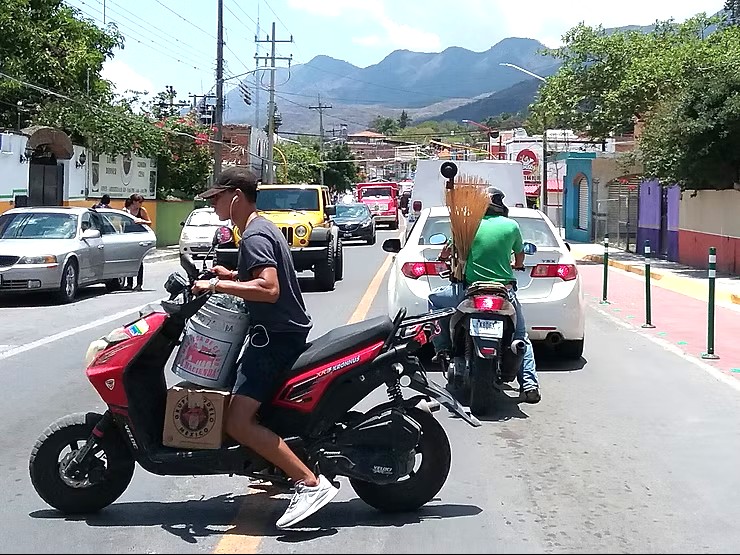
Motorcycles are widely used at Lakeside, and are a practical option for navigating the narrow streets of Ajijic and Chapala. They require the same Class A driver’s license as a car in Jalisco. Mexican motorcycle insurance is required by law under Jalisco’s Movilidad Law, covering at minimum 403,740 pesos for bodily injury and property damage to third parties.
At checkpoints, officers typically check for:
- Valid driver’s license — must be a current Class A Jalisco license or valid foreign license appropriate for motorcycle operation. Carry the original. Copies are not accepted.
- Tarjeta de circulación — the vehicle registration card. This must be current and match the motorcycle. You must carry it at all times.
- Proof of insurance — your Mexican motorcycle insurance policy card or document. This is legally required and will be checked.
- Helmet — Jalisco law explicitly requires both the rider and any passenger to wear a properly fastened helmet with safety straps secured. Riding without a helmet is an infraction under Jalisco’s Movilidad Law Article IV. Officers at checkpoints will note an unfastened or improperly worn helmet as well as an absent one.
- Functional safety equipment — lights, mirrors, and other required equipment in working order.
-
Passengers – Mexican law allows only one passenger on a motorcycle. No exceptions. The passenger must wear a properly fastened helmet, exactly as the rider does. There is also a practical safety requirement that applies in Jalisco: a passenger must be able to reach the footpegs. This rule exists because a passenger who cannot reach the pegs cannot brace properly in the event of sudden braking or an accident, creating a genuine safety hazard. In practice this means small children cannot legally or safely ride as motorcycle passengers, regardless of how short the trip is.
Officers at checkpoints will note an unhelmeted passenger or an improperly positioned one. Fines apply to both the rider and the overall infraction, not just to the individual without the helmet.
Fines for missing documentation or equipment infractions are issued on the spot. Riding without insurance, without a valid license, or without a helmet are the most commonly cited infractions at Lake Chapala area checkpoints.
Buying a motorcycle at Lakeside
Motorcycles can be purchased at dealerships in Guadalajara. Popular brands include Honda, Yamaha, and Italika, the latter being a Mexican brand with an extensive dealer and parts network throughout Jalisco, making maintenance and parts sourcing particularly straightforward for Lakeside residents. For basic daily transport around the corridor, a mid-range Italika is a practical and economical choice.
Golf Carts
Golf carts occupy a genuinely ambiguous legal space at Lake Chapala, and it is worth understanding exactly what that ambiguity means before you rent or buy one.
What is legal: Golf carts can circulate on interior village streets in Ajijic — the side streets and cobblestone roads away from the main highway. A verbal agreement between the Chapala Mobility Chief and the municipal government allows them to operate on these streets without interference, provided they are driven by a licensed driver.
What is illegal: Golf carts cannot drive on the carretera, the main highway running through Ajijic. They may cross it at traffic lights to get between the lakeside and mountainside parts of town, but they cannot travel along it. They also cannot use the libramiento, the road leading up to the Guadalajara highway.
The licensing problem: Jalisco’s traffic laws do not formally recognize golf carts as street-legal vehicles, and Chapala’s state tax office has stopped issuing license plates for them. Some carts have motorcycle plates obtained elsewhere. Carts with such plates may avoid some issues by staying on back streets. But the situation is informal and subject to change. Carts detected on the highway face fines and potential impoundment.
Golf cart rentals are available in Ajijic for tourists and visitors. Lakechapalagolfcarts.com is one established operator. For residents considering ownership, the legal ambiguity and licensing complications make this a decision worth thinking through carefully.
Moto-Taxis — Three-Wheeled Vehicles
The three-wheeled enclosed motorcycle vehicles, variously called moto-taxis, moto-cars, or trimotose, are a common sight throughout the Lake Chapala area, particularly in Chapala town and outlying villages. They operate as informal taxis for short local trips, and are used by many Mexican residents for daily transportation.
For expats, they are an inexpensive and practical option for very short trips within a town center, particularly useful for people who find walking difficult or who simply want a quick covered ride to the market.
Fares are negotiated directly with the driver and are extremely low by any standard — typically 20 to 40 pesos for a short town trip. They are not metered and are not regulated as formal taxis. They operate entirely on informal local custom.
Commercial operation of a moto-taxi requires a commercial driving license in theory, though in practice this is informally regulated. As a passenger, your only practical consideration is basic safety awareness. These vehicles are slower and less stable than cars, and are best suited to short trips on local streets rather than highway travel.
Walking, Cycling, and Bikes
Walking
Ajijic Centro and Chapala town are both highly walkable for residents with comfortable mobility. The malecon areas, markets, restaurants, galleries, and most daily needs are accessible on foot in both town centers. The cobblestone streets are charming but uneven. Good walking shoes with ankle support are genuinely recommended, particularly for older residents.
Cycling — the practical reality
Cycling is popular among expats at Lakeside, but the terrain and traffic require realistic expectations. The carretera is not suitable for casual cycling. It carries fast-moving traffic including trucks and buses, and sharing it with motor vehicles is genuinely dangerous. Interior cobblestone streets are more pleasant but can be hard on conventional bikes and riders.
A dedicated ciclovía, cycling path, runs along the corridor and provides a safer option for recreational riding. The relatively flat terrain near the lake makes cycling practical for fit riders.
Electric bikes — increasingly the vehicle of choice
Electric bikes, e-bikes, have become genuinely popular at Lake Chapala over the past few years and deserve special mention. For expats who want the freedom of independent transport without the complications of car ownership, an e-bike is increasingly a practical answer.
The advantages are significant:
- No license required — e-bikes are not classified as motor vehicles under Mexican law and require no driver’s license, registration, or insurance
- No TIP complications for permanent residents
- Inexpensive to buy — quality e-bikes are available in Guadalajara from approximately 8,000 to 25,000 pesos
- Cheap to run — charging costs pennies
- Can handle the hills above the carretera that would defeat a conventional cyclist
- Easy to park anywhere
The main limitation is range — most e-bikes provide 40 to 80 kilometers per charge depending on terrain and assist level, which is more than sufficient for daily Lakeside errands but not suitable for Guadalajara trips.
Where to buy bikes at Lakeside
Bicycle shops are found along the carretera and in Chapala town. For e-bikes specifically, Guadalajara has a much wider selection. The Tlaquepaque and Zapopan areas have dedicated e-bike dealers. Several Lakeside expats have had good experiences ordering through Mercado Libre (mercadolibre.com.mx) with delivery to their door.
Bike safety
Helmets are strongly recommended even where not legally required. Lights front and rear are essential for any riding after dark. A good quality lock is a practical necessity. Bike theft is a real risk at Lakeside.
Part Three: Taxis and Ride-Hailing
Local Taxis
Traditional taxis are plentiful throughout the Lakeside area. You can find them at the main plaza in Ajijic and Chapala, at taxi stands throughout the corridor, and by calling local taxi dispatch numbers.
Taxis at Lake Chapala are not metered — fares are fixed by zone and negotiated with the driver. The going rates in 2026:
| Trip | Approximate fare |
|---|---|
| Within Ajijic or Chapala town | $50–90 pesos |
| Ajijic to Chapala | $80–120 pesos |
| Ajijic to Jocotepec | $120–180 pesos |
| Ajijic to Guadalajara airport | $400–600 pesos |
| Chapala to Guadalajara airport | $350–500 pesos |
Establish the fare before getting in. Most local taxi drivers speak enough English to handle basic transactions. Tipping is not expected for local trips but is appreciated.
Taxi dispatch numbers for Ajijic: (376) 766-1663 and (376) 766-0674. For Chapala: (376) 765-4697.
Uber and DiDi
Uber is available at Lake Chapala but coverage is thin. There are drivers registered in the Ajijic area, but surge pricing is common, and wait times can be long, particularly at night and during off-peak hours. For trips to and from Guadalajara, Uber works reliably once you are in the metropolitan area. The Guadalajara airport has a designated Uber pickup area.
DiDi — a Chinese ride-hailing platform that competes aggressively with Uber in Mexico has limited presence at Lakeside specifically, though it operates robustly throughout Guadalajara. For local Lakeside trips, traditional taxis remain more reliable than either platform.
For getting to and from Guadalajara airport, a pre-arranged private transfer or traditional taxi is often more reliable than waiting for an Uber at Lakeside. Fares from Ajijic to GDL airport run approximately 400 to 600 pesos by negotiated taxi, comparable to or slightly cheaper than Uber surge pricing for the same trip.
One important note about GDL airport: Uber and DiDi cannot pick up passengers at the Guadalajara Airport terminal itself. For the return journey from the airport, you must use official airport taxis or arrange a pre-booked private transfer. You can, however, use Uber and DiDi to get to the airport from anywhere in Guadalajara.
Private Drivers
Several private transfer companies and individual drivers specialize in the Lakeside to Guadalajara airport run. These are pre-booked, fixed-price services that pick you up at your door and deliver you to the terminal. For airport trips, particularly early morning departures or late arrivals, a pre-booked private transfer is the most reliable option.
Rates run approximately 600 to 900 pesos depending on the company and pickup location. Ask for recommendations from your neighbors, the Lake Chapala Society, and the webboard on chapala.com. Local word of mouth is the most reliable source for current driver recommendations.
Part Four: Buses
Local Buses — Along the Corridor
Local buses run continuously along the carretera connecting all the towns from Chapala to Jocotepec, passing through San Antonio Tlayacapán, Ajijic, and San Juan Cosalá. They run approximately every 15 minutes throughout the day.
Local bus fare: approximately 12 to 15 pesos, under $1 USD. You pay the driver when you board. Buses stop anywhere along the route when flagged. There are no fixed stops as such. To get off, call out “bajan” (getting off) or push the button if one is installed.
For short trips along the corridor — Ajijic to Chapala, Riberas to San Antonio — the local bus is the most economical option and perfectly comfortable for the purpose.
Buses to Guadalajara
There are actually two separate bus stations serving the Lakeside area:
1. Central Autobuses de Chapala — the main bus station in Chapala town, located at Francisco Ignacio Madero S/N, Col. Centro, Chapala. This is where buses to and from Guadalajara depart and arrive. The Yelp listing notes it serves the Chapala Plus express service (assigned seats, air conditioning, no standing passengers), as well as regular buses.
2. Transportes Chapala Bus Station — located at Carretera Ote. 8B, Ajijic — this appears to be the local corridor bus stop/station in Ajijic, operating 5:20am to 9:40pm.
Buses depart approximately every 30 minutes in the morning and every hour in the afternoon.
The bus to Guadalajara costs approximately 55 to 70 pesos — $3 to $4 USD — and takes 45 to 60 minutes to the Guadalajara bus terminal, depending on traffic.
There are two options: a direct express service and a local service that makes more stops. The express is worth the marginally higher fare.
From Guadalajara’s Antigua Central Camionera bus station, connections are available to destinations throughout Jalisco and beyond.
Long-Distance Buses
For travel to Puerto Vallarta, Manzanillo, Mexico City, or other major destinations, first-class bus service is available from Guadalajara’s main bus terminals. The two primary terminals are the Nueva Central Camionera (for most long-distance routes) and the Antigua Central Camionera (for some regional routes).
Premier first-class bus lines serving routes from Guadalajara include:
ETN Turistar — Mexico’s premium bus service, with reclining seats, meals, and entertainment on longer routes. Highly recommended for overnight journeys.
Primera Plus — Excellent first-class service covering major routes including Puerto Vallarta, Mexico City, and the Pacific coast.
Flixbus — A European operator that entered the Mexican market in recent years, offering competitive pricing on major routes.
Mexican first-class buses are genuinely comfortable and a legitimate alternative to flying for routes of four to six hours or less. The Guadalajara to Puerto Vallarta route (approximately 5 hours) is a classic example where the bus is often more practical than flying once airport time is factored in.
Bus from GDL Airport to Guadalajara
The C98 Airport bus connects Guadalajara Airport with central Guadalajara for approximately 10 to 15 pesos. It follows the Chapala highway corridor. This is a budget option most useful for travelers with light luggage and no onward connection to Lakeside. Getting from the airport bus to Lakeside still requires a separate taxi or bus connection.
Part Five: Getting to Guadalajara Airport
The Guadalajara International Airport (GDL) — officially the Miguel Hidalgo y Costilla International Airport — is the primary airport serving Lake Chapala residents and is approximately 50 to 60 kilometers from Ajijic.
Your options:
| Option | Cost | Notes |
|---|---|---|
| Pre-booked private transfer | $600–900 pesos | Most reliable; door to terminal |
| Negotiated taxi | $400–600 pesos | Establish fare before departing |
| Uber (from Guadalajara) | $800–1,300 pesos | Variable; cannot pick up at terminal |
| Car rental | From $500 pesos/day | Useful if staying in Guadalajara |
Allow at least 90 minutes from Ajijic to the airport under normal traffic conditions, and two hours during morning rush hour or on holiday weekends. The Guadalajara-Chapala highway can back up significantly during peak times.
Airlines serving GDL
Guadalajara is Mexico’s second-largest city and its airport serves a wide range of domestic and international destinations. Major airlines including Aeromexico, Volaris, VivaAerobus, American, United, Delta, Air Canada, and others serve GDL with connections to US, Canadian, and international destinations. Direct flights to many US hub cities are available, making GDL a genuinely convenient airport for North American expats.
Part Six: Other Ways to Get Around
Tours
The Lake Chapala area is well-served by tour operators offering excursions to Guadalajara, Tlaquepaque, Tonalá, Tequila, and other regional destinations. These are particularly popular among snowbirds and newer arrivals who want to explore the region without the challenge of navigating Guadalajara traffic independently.
The Lake Chapala Society maintains a list of recommended tour operators. Several Ajijic-based operators offer regular scheduled tours as well as private arrangements.
The Tequila Express
The Tequila Express is a popular tourist train running from Guadalajara to the town of Tequila, home of Mexico’s most famous spirit, with mariachi music, food, and distillery visits included. It departs from Guadalajara’s historic train station on weekends and selected dates. While primarily a tourist experience rather than a transportation option, it is genuinely enjoyable and popular among Lakeside expats for day trips. Tickets run approximately $100 to $150 USD per person including all activities. Book in advance at tequilaexpress.mx.
There is no regular passenger train service connecting Lake Chapala to Guadalajara or other destinations. Mexico’s intercity rail network is extremely limited and does not serve the Lakeside corridor.
The Bottom Line
Getting around at Lake Chapala is genuinely manageable — and for daily life within the corridor, straightforward. Taxis are cheap, local buses are frequent and inexpensive, and the corridor is compact enough that walking covers most needs in the town centers. E-bikes have emerged as an increasingly popular option for independent daily transport without any of the complications of car ownership.
The complications arise primarily around vehicles: the TIP restrictions for permanent residents, the nationalization costs, the January 2025 change to Jalisco’s licensing requirements, and the ambiguous status of golf carts. None of these are insurmountable, but all of them reward advance planning over last-minute improvisation.
Get your Mexican driver’s license in your first year. Sort out your vehicle situation before upgrading to permanent residency. Keep your insurance current. And use Uber or a taxi after dinner.
Useful contacts:
- Chapala taxi: (376) 765-4697
- Ajijic taxi: (376) 766-1663 / (376) 766-0674
- Chapala bus station: (376) 765-2221
- Guadalajara airport (GDL): aeropuertoguadalajara.com
- Tequila Express: tequilaexpress.mx
- Vehicle registry check: repuve.gob.mx
- Jalisco SeMov (driver’s licenses): semov.jalisco.gob.mx
- Parker Insurance: Hidalgo 81, Riberas del Pilar — (376) 765-5287
For a comprehensive reference to Jalisco’s vehicle and traffic laws in English, Lakeside attorney Lic. Spencer McMullen has published a useful guide at chapalalaw.com/Driving.pdf. This is worth bookmarking before you need it.
Next in the Lake Chapala Insider: the Lake Chapala Society and expat community organizations — what they offer, how to get involved, and why they matter more than newcomers expect.